I Spent 200 Hours Reading Quantum Computing Papers So You Don't Have To. Bitcoin Is Fine.
 Read the original thread on X
Well, mostly fine. The truth is more interesting than the panic — and more urgent than the dismissals.
TL;DR for Skimmers
- Bitcoin does not use encryption. It uses digital signatures. Most articles get this wrong, and the difference matters.
- Quantum computers cannot “crack Bitcoin in 9 minutes.” That headline describes a theoretical circuit on a machine that doesn’t exist and won’t for at least a decade.
- Quantum mining is physically impossible. It would require more energy than the Sun produces. Seriously.
- Bitcoin CAN upgrade — it has before (SegWit, Taproot) — and work has started (BIP-360). But the community needs to move faster.
- There IS a real concern: ~6.26 million BTC have exposed public keys, and the qubit gap is closing faster than anyone predicted. This isn’t a thing to panic about. It’s a thing to prepare for.
The Throughline
Here’s the one-sentence version of everything I’m about to tell you:
The quantum threat to Bitcoin is real but distant, the media coverage is systematically unhinged, and the most dangerous thing isn’t quantum computers — it’s complacency disguised as either panic or dismissal.
Both the “Bitcoin is doomed!” crowd and the “Nothing to see here!” crowd are wrong, in ways that are equally unhelpful. The truth requires holding two ideas simultaneously: (1) there is no imminent quantum threat to your Bitcoin, and (2) the Bitcoin community has about a decade to implement changes that will take 7-10 years.
That’s a tight window. But it’s a window — not a wall.
Let me show you the math.
Part 1: The Media Machine (Or, Why Headlines Are the Real Threat)
Every few months, the same cycle repeats:
- A quantum computing lab publishes a careful, heavily caveated research paper
- Tech media writes: “QUANTUM COMPUTERS COULD CRACK BITCOIN IN 9 MINUTES”
- Crypto Twitter compresses this to: “BITCOIN IS DEAD”
- Your uncle texts you asking if he should sell
- The actual paper says nothing of the sort
In March 2026, Google’s quantum AI team published a paper showing that breaking Bitcoin’s elliptic curve cryptography would require fewer than 500,000 physical qubits — a 20x improvement over prior estimates. This is genuinely important research. Google was so serious about responsible disclosure that they withheld the actual attack circuits and published only zero-knowledge proofs.
What the paper did NOT say: that Bitcoin can be cracked today, that a timeline exists, or that anyone should panic.
What the headlines said: “Bitcoin cracked in 9 minutes.”
CoinMarketCap ran an article titled “Will AI-Accelerated Quantum Computing Break Bitcoin in 2026?” The article then spent its entire body explaining why the answer is “almost certainly no.” This is the standard pattern: sensational headline for clicks, cautious body for accuracy. But 59% of shared links are never clicked — so the headline IS the message for most people.
Raoul Pal had the best economic debunk: “Markets price risk extremely fast. You wouldn’t steal something that collapses in value the moment you take it.” If quantum computing were about to break everything, Google itself — which uses the same cryptography — would show panic in its stock price. GOOG is doing fine.
The takeaway: The headlines are the real misinformation. The research is real and worth understanding. Let’s do that.
Part 2: What Quantum Computers Actually Threaten (And What They Don’t)
The #1 Misconception: “Encryption”
Nearly every article about quantum computing and Bitcoin uses the word “encryption.” This is wrong, and the error changes everything.
Bitcoin does not use encryption to secure your funds. It uses digital signatures (ECDSA, and more recently Schnorr via Taproot). The blockchain is public by design — all transaction data is visible to everyone, always. There is nothing to “decrypt.”
As Adam Back — inventor of Hashcash (cited in the Bitcoin whitepaper) — puts it: “Encryption implies data is hidden and can be decrypted. Bitcoin’s security model is based on signatures that prove ownership without exposing the private key.”
This isn’t a semantic quibble. It means the “harvest now, decrypt later” threat — the strongest urgency argument in quantum computing — largely doesn’t apply to Bitcoin fund security. There’s nothing encrypted to harvest. The public keys that are exposed are already sitting in the open on the blockchain.
(There is a privacy nuance here — a quantum computer could link identities to transactions by deriving public keys from addresses — but that’s a privacy concern, not a “your coins are stolen” concern.)
The Two Algorithms: One Matters, One Doesn’t
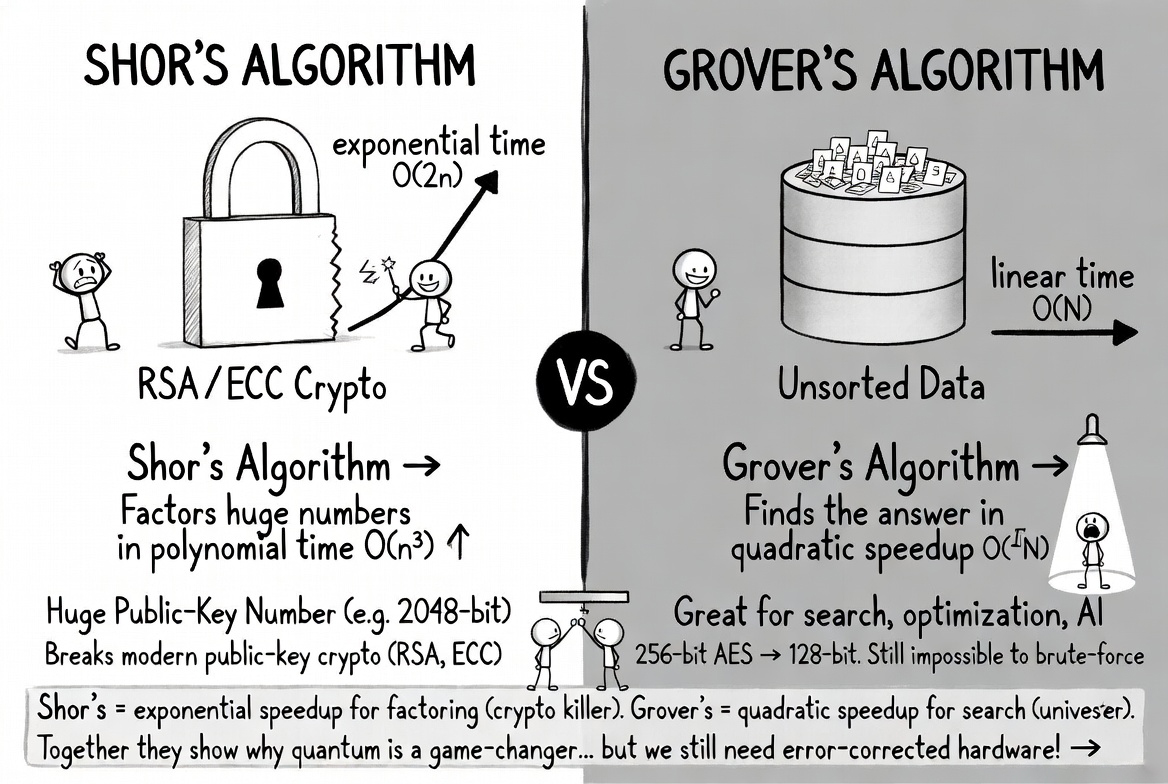
(Stick-figure diagram style borrowed from Tim Urban’s Wait But Why — if you haven’t read his work, you should.)
Shor’s Algorithm (the real threat): Provides an exponential speedup for breaking the mathematical problem underlying digital signatures (ECDSA). This would allow someone to derive your private key from your public key, and sign transactions as if they were you. This is the thing to actually worry about.
Grover’s Algorithm (not the threat): Provides only a quadratic speedup for attacking hash functions like SHA-256 (Bitcoin mining). This sounds scary until you do the math.
A 2025 paper titled “Kardashev Scale Quantum Computing for Bitcoin Mining” calculated what Grover’s algorithm would actually require at Bitcoin’s real-world difficulty level:
- ~10²³ physical qubits (we currently have about 1,500)
- ~10²⁵ watts of power (the Sun produces ~3.8 × 10²⁶ watts)
To mine Bitcoin with a quantum computer, you would need to harness a significant fraction of the Sun’s total energy output. We are a Kardashev Type 0.73 civilization. This is a Type II requirement.
For context: an “optimistically specified” quantum miner achieves about 13.8 GH/s. A single Antminer S21 does 200 TH/s. The classical ASIC is 14,500 times faster.
The stat to text your friend:
Mining Bitcoin with a quantum computer would require 10²⁵ watts of power — roughly 3% of the Sun’s total energy output. The entire planet Earth currently uses about 1.8 × 10¹³ watts. You’d need to multiply humanity’s total energy consumption by a trillion to quantum-mine a single block.
A $2,000 ASIC from Amazon is 14,500x faster than the best theoretical quantum miner. The quantum computer costs billions and needs to be cooled to near absolute zero. The ASIC plugs into a wall outlet.
Quantum mining isn’t hard. It’s thermodynamically absurd.
Bottom line: Quantum mining is not a thing. Not now, not in 50 years, possibly not ever. If someone tells you quantum computers will “break Bitcoin mining,” they have confused two fundamentally different algorithms.
Part 3: The 8 Claims You’ll Hear (And Why 7.5 of Them Are Wrong)
Let me walk through the specific FUD claims in circulation and give you the counterargument for each. I’m using a half-point because one of these claims is half-right.
Claim 1: “All Bitcoin can be stolen overnight once quantum computers arrive”
Reality: Only Bitcoin with exposed public keys is vulnerable. Modern Bitcoin addresses (P2PKH, P2SH, SegWit) do not expose your public key until you spend from them. If you’ve never reused an address and never spent from it, your public key is not on the blockchain.
The breakdown: - Tier A (immediately vulnerable): ~1.7 million BTC in old P2PK format — keys visible right now - Tier B (vulnerable, but fixable): ~5.2 million BTC in reused addresses and Taproot — users can migrate - Tier C (briefly vulnerable): Every transaction is exposed during the ~10 minutes it sits in the mempool
Total: about 6.26 million BTC with exposed keys (Chaincode Labs estimate). That’s ~30-35% of the supply — significant, but not “all Bitcoin.”
Claim 2: “Satoshi’s coins will be stolen, crashing the market to zero”
Half-right: Satoshi’s ~1.1 million BTC are in P2PK format with exposed keys. They ARE among the most vulnerable coins. But:
- Stealing them requires a machine that does not exist
- Nation-states with early quantum capability would target intelligence and military systems — not attempt “what would be a very public Bitcoin theft PR stunt” (as the Quantum Canary research group puts it)
- The Bitcoin community would have years of warning from visible hardware milestones and could implement protocol changes (freeze, migrate, or burn vulnerable UTXOs) before theft becomes practical
Claim 3: “Bitcoin can’t upgrade — it’s too slow and ungovernable”
False, but not without nuance. Bitcoin has successfully executed major upgrades:
- SegWit (2015-2017) — Extremely contentious, near-failure, caused the Bitcoin Cash fork. But it shipped.
- Taproot (2018-2021) — Smooth activation, ~3.5 years from proposal to live on mainnet.
BIP-360, the leading quantum-resistant proposal, was merged into Bitcoin’s BIP repository in early 2026. It introduces a new address type (bc1z) that removes Taproot’s quantum-vulnerable key-path spend. It’s in Draft status, with a testnet already running Dilithium post-quantum signature opcodes.
Ethan Heilman, BIP-360 co-author, estimates the full process at about 7 years: 2.5 years of development and review, 0.5 years for activation, and 4 years for ecosystem migration. He readily admits: “I’m just spitballing here. No one actually knows.”
The honest answer: Bitcoin can upgrade and has started, but the process is early-stage and needs to accelerate. The claim it’s “impossible” is false. The claim it’s “done” is also false.
Claim 4: “We only have 3-5 years”
Probably wrong, but not safely wrong. Expert estimates span a huge range:
- Adam Back (Hashcash inventor, cited in Bitcoin whitepaper) — 20-40 years
- Craig Gidney (Google Quantum AI) — 10% chance of a cryptographically relevant quantum computer by 2030
- Expert survey (26 quantum security researchers) — 28-49% chance within 10 years
- Ark Invest — “Long-term, not imminent”
One thing worth understanding: quantum computing progress is not always linear and visible. Google’s Willow chip crossed the “below-threshold” barrier for quantum error correction in late 2024 — meaning that from this point on, adding more qubits makes the system exponentially better, not incrementally better. That’s a phase transition, not a smooth curve. Google itself withheld its actual attack circuits from the March 2026 paper, publishing only zero-knowledge proofs. And Scott Aaronson has warned that at some point, researchers will stop publishing resource estimates for breaking cryptography. So the assumption that we’ll see Q-Day coming from a mile away is not guaranteed.
That said, building a machine with hundreds of thousands of fault-tolerant qubits is still an enormous engineering challenge. No quantum computer has ever factored a number larger than 13 digits. Breaking Bitcoin’s cryptography requires the equivalent of factoring ~1,300-digit numbers. That’s not a gap that closes overnight — but the trajectory deserves respect, not dismissal.
Claims 5-8: Quick Hits
“Quantum breaks mining” — No. Requires the Sun’s energy output. See Part 2.
“Harvest now, decrypt later” — Doesn’t apply to fund theft (blockchain is already public). Does apply to privacy (a legitimate but lesser concern).
“Google says 9 minutes” — Google says a theoretical circuit could run in 9 minutes on a 500,000-qubit machine that doesn’t exist. Google cautioned against FUD. Google withheld the attack circuits.
“Post-quantum crypto isn’t ready” — NIST has already standardized ML-KEM, ML-DSA, and SLH-DSA. The algorithms exist. The challenge is deploying them in Bitcoin, not inventing them.
Part 4: The Honest Part (What I Worry About)
A debunking article that dismisses everything loses credibility. Here are the five things that keep me up at night:
1. The qubit estimates are collapsing. In 2012, breaking cryptography required an estimated 1 billion qubits. By 2019: 20 million. By 2025: under 1 million. In early 2026, Oratomic demonstrated feasibility with as few as 10,000 physical qubits using neutral-atom architecture. Nobody knows when the “qubits needed” and “qubits available” lines cross. The honest answer is genuine uncertainty.
2. The exposed surface is growing, not shrinking. Taproot — Bitcoin’s newest and most promoted address format — exposes tweaked public keys on-chain, giving quantum attackers an indefinite offline window. Bitcoin’s most recent upgrade made things worse for quantum resistance. That’s an irony worth sitting with.
3. Bitcoin’s governance is slow. No soft fork has activated since November 2021 — over four years of base-layer stasis. Google targets 2029 for its own post-quantum migration. Bitcoin’s most optimistic estimate is 2033. If a CRQC arrives before ~2035 (28-49% of experts consider this plausible), Bitcoin faces a genuine race condition.
4. Satoshi’s coins are an unsolvable game-theory problem. ~1.1 million BTC in P2PK addresses that can never be migrated because no one holds the keys (or Satoshi is absent). The options — do nothing, freeze, burn — all have serious consequences. There is no clean solution.
5. The blockchain is a permanent target list. Every exposed public key is catalogued forever at zero cost. Nation-states can prepare now and wait. Defense requires active coordination; attack requires only patience.
These aren’t FUD. These are engineering challenges that deserve engineering responses — which is exactly what the Bitcoin developer community is working on.
Part 5: So What Should You Actually Do?
If you’re a Bitcoin holder:
- Don’t panic. The threat is real but distant. You have time.
- Stop reusing addresses. Your public key is hidden behind a hash, but only until you spend. Once you spend from an address, the key is on-chain and any funds received afterward are exposed. Taproot (bc1p) is the exception — it exposes the tweaked public key immediately, no spending required. Use fresh addresses for every receive.
- Watch for BIP-360. When quantum-resistant address types become available, migrate your funds.
- If you’re holding long-term, consider keeping funds in addresses you’ve never spent from. Your public key stays hidden.
- Ignore the headlines. Read the actual papers. They’re more interesting and less scary than the coverage suggests.
If you’re a Bitcoin developer:
- BIP-360 needs more reviewers. The testnet is running. The code needs eyeballs.
- The 7-year timeline needs to compress. Every year of delay narrows the safety margin.
- Start the governance conversation about legacy UTXOs. Satoshi’s coins won’t protect themselves. The community needs a plan.
If you’re someone who just read a scary headline:
Remember that 59% of shared links are never clicked. The headline is designed to make you feel something. The paper underneath is designed to make you think something. Go read the paper.
The Real Story
The quantum threat to Bitcoin is not a binary — it’s a spectrum. On one end: “Bitcoin is doomed and you should sell everything.” On the other: “Nothing to see here, quantum is a hoax.” Both ends are wrong.
The truth sits in a specific, actionable middle: Bitcoin has a real engineering challenge with known parameters, active development, and a timeline that is tight but manageable — if the community treats it with appropriate urgency.
The most dangerous thing isn’t quantum computers. It’s the media cycle that oscillates between panic and dismissal, making it impossible for anyone to think clearly about what is fundamentally a solvable problem.
Bitcoin has survived the block size wars, exchange hacks, regulatory assaults, and its own creator disappearing. It will survive quantum computing — but only if the community starts preparing now, not in a panic, but with the steady, methodical engineering focus that has always been Bitcoin’s greatest strength.
The house isn’t on fire. But the gas line is leaking and the smoke detector needs batteries. Time to get to work.
Sources: 66 research documents across two topic wikis spanning quantum computing resource estimates, Bitcoin vulnerability analysis, debunking psychology, and content virality research. Key sources include Google Quantum AI (2026), Kardashev Scale Mining Paper (2025), BIP-360 documentation, Berger & Milkman (2012), the Debunking Handbook 2020, and practitioner accounts from Tim Urban, Dan Luu, and patio11. Full wiki available for peer review.